


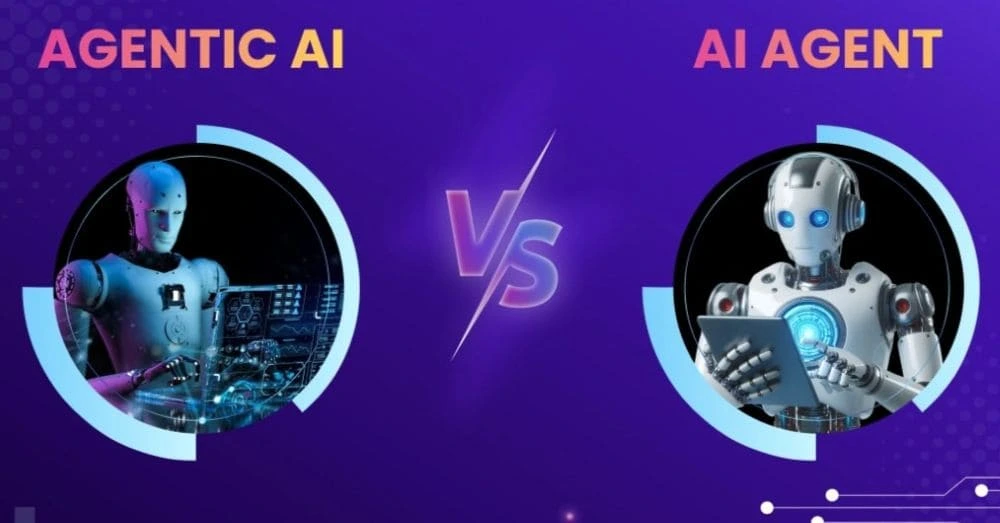
Our customers often ask us what the difference is between AI Agents and AgenticAI. To answer this, we must first understand what Large Language Models (LLMs) are and what Retrieval Augmented Generation (RAG) is.
An LLM is a language model trained on millions of texts, usually public, using neural networks that learn both information and language. If we want to use proprietary or non-public documents, we can train our own LLM, but it is an expensive process that requires a great deal of properly curated data, and that is where the RAG paradigm comes in.
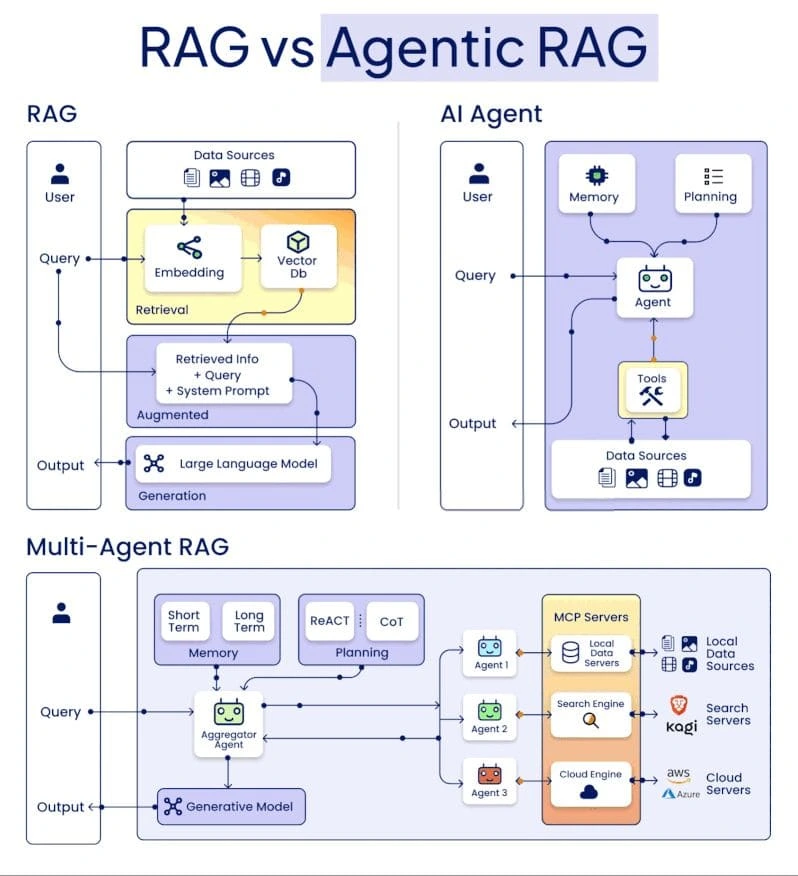
RAG allows an LLM to be used as a general language model and combined with internal documents to extend the LLM’s knowledge base. When a user asks a question, the words contained therein are analysed to identify relevant information in the knowledge base, and then the LLM’s narrative capabilities generate a coherent response based on the references activated.
On this basis, AI Agents emerge, functioning as autonomous components capable of maintaining their status and connecting to information sources to fulfil their objective. Unlike an RAG system, which responds to a specific question, an agent is geared towards solving a task through multiple steps.
Finally, AgenticAI or Multi-Agent is based on the coordination of multiple specialised agents that collaborate with each other to solve a complex problem, weighing up the different skills that each agent has and making a collective decision on the best course of action. AgenticAI uses advanced reasoning chains (ReAct, CoT) to determine the best plan of action to achieve the objectives.
At WayOps, we are already using AI Agents and AgenticAI in real applications to automate quality processes, improve customer service, and increase the efficiency of industrial processes. If you want to discover how to apply generative AI in your business, WayOps can help you explore new use cases and optimise critical processes.
If you want to discover how to apply generative AI in your business, WayOps can help you explore new use cases and optimise critical processes.



No hay comentarios