


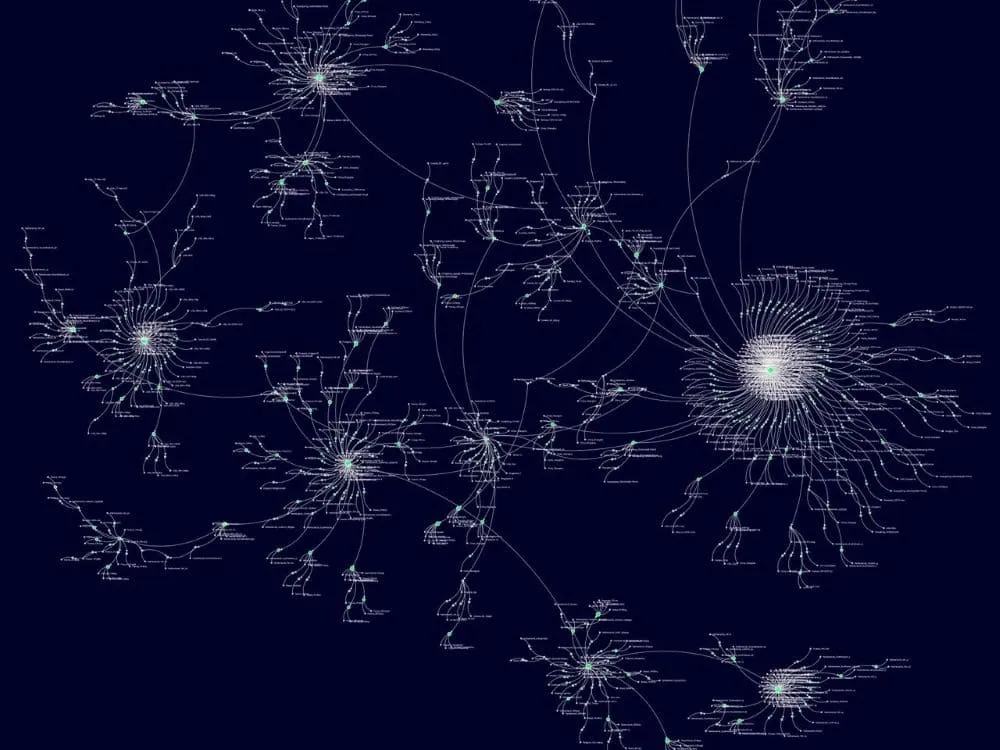
Data has become a top-level business asset for the world’s leading companies. However, the vast majority of companies still work with data in table format, which limits the possibilities for exploitation and reduces the information available for decision-making.
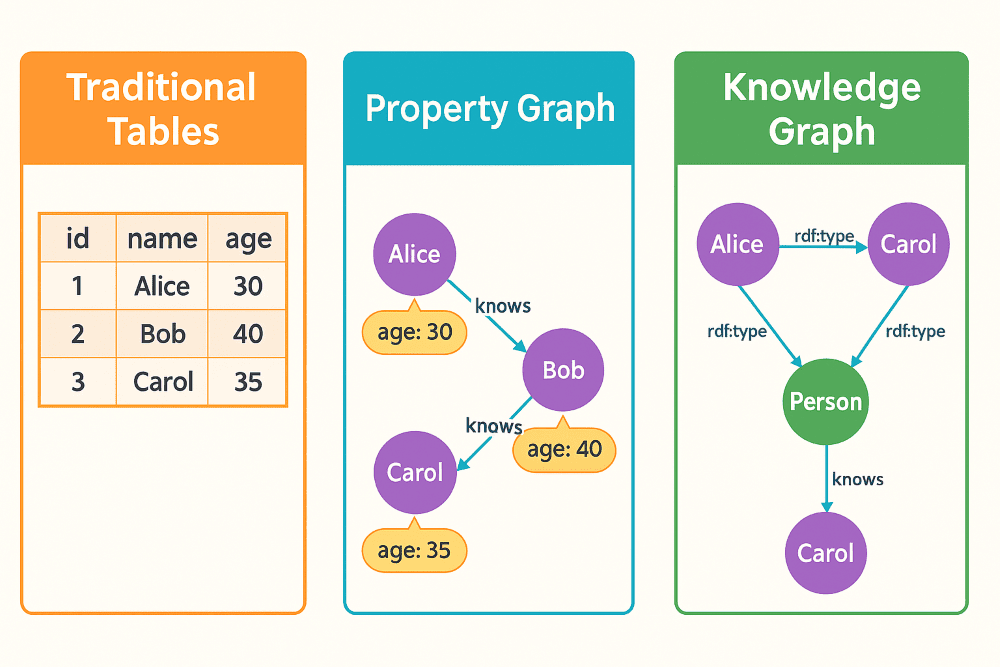
Table-based data models, or entity-relationship models, minimise information and enable simple queries using SQL. However, this paradigm has limitations in use cases with massive relationships, such as social networks, route navigation, or scientific applications.
At the beginning of the 21st century, Property Graphs emerged, consisting of nodes connected to each other by edges, as a new paradigm for accessing data that allows thousands of relationships to be navigated and the limitations of the relational model to be overcome. To explore these relationships, OLTP approaches are used, aimed at searching for specific nodes or paths, and OLAP, which applies algorithms to the entire graph. Subsequently, Knowledge Graphs appeared as a specific application for modelling language. Standards such as RDF, RDFS and OWL allow for the standardisation of information storage, and their ontological nature makes it possible to perform logical inference to derive new knowledge from existing knowledge. A standard query language and the possibility of using vocabularies to expand knowledge position Knowledge Graphs as an ideal information paradigm for documents.
At WayOps, we have been developing solutions based on Property and Knowledge Graphs for sectors such as Education, Transport, and Insurance for over five years. We are currently immersed in the development of generative AI systems that use graphs as a source of information. Contact us to explore use cases in your industry.



No hay comentarios